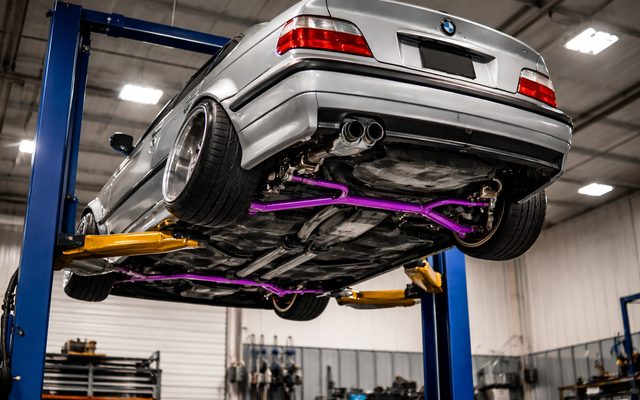
In the high-stakes arena of modern professional sliding, podium finishes is no longer solely a product of brute torque or behind-the-wheel aggression. Instead, it has become a complex discipline that requires a painstaking marriage of picking a proven vehicle platform, outfitting it with the most precise drift-spec parts, and, most essentially, grasping its live characteristics on the course through cutting-edge drift telemetry software. This exhaustive manual functions as your master plan starting from the very first concept of a project car right through to the final data-informed tweaks that elevate a powerful machine into a repeatable champion. We will examine in detail the methodical process of chassis dynamics adjustment, illustrating how a state-of-the-art drift tuning app like GripDial removes assumptions and delivers unparalleled clarity into your vehicle's real-world behavior.
The foundation of any great drift car is, indisputably, the platform itself. Certain vehicles have earned legendary standing within the worldwide drifting culture due to their natural balance, durable build quality, and the vast range of aftermarket components available. Choosing the optimal car is the first and most significant choice a driver will make. As an example, the BMW E36 is commonly accepted as one of the greatest all-around cars for drifting of history. Its excellent balanced front-to-rear weight, coupled with a RWD setup and extremely reliable six-cylinder engines, forms a chassis that is simultaneously forgiving for novices and incredibly capable in the possession of a professional competitor. The evolution of this concept, the BMW E46 platform, builds upon these attributes with a even more refined structure, increased track for improved confidence, and yet more lock as standard from the factory. A different dominant option in the professional circuit is the C6 generation Corvette.
This American performance car brings a unique array of advantages to the sideways sport, including a lightweight aluminum frame, a backwards-positioned drivetrain component that contributes to an ideal balance, and the tremendous thrust of a large-displacement LS V8 motor. This fusion transforms it into an complete weapon on track, capable of initiating and holding extended slides with apparently easy use of acceleration. For drivers desiring exceptional value, the Nissan 350Z stands out as a prime example. It arrives from the factory with a stiff platform, a decent original locking differential, and the responsive V6 motor that offers sufficient horsepower and torque for mastering and progressing in the sport. Its successor, the 370Z model, presents additional refinements in chassis stiffness, steering geometry, and overall motor output, solidifying its place as a favorite selection among professional drivers. Additional iconic vehicles that warrant attention are the agile Wankel-engined Mazda FC RX-7, the ever-present S13 Silvia/240SX, the V8-powered SN95 generation Mustang, the more recent BMW E90, and the tiny yet incredibly fun and forgiving MX-5 Miata. Every single one of these chassis offers a distinct set of traits, difficulties, and capabilities, but they all have in common the fundamental ingredients essential to become a competitive sliding vehicle.
However, picking the optimal platform is merely the beginning. To access the complete capability of any of these vehicles, major upgrades to the steering and damping and springing systems are utterly mandatory. This is where the world of specialist tuning components becomes critical view. The one most transformative improvement for a purpose-built drift machine is the integration of a drift-spec angle modification kit. These engineered systems, for example those engineered by specialist companies like SLR Speed, are designed to radically expand the chassis's available steering angle. A OEM street car is extremely limited in how far its tires can turn, a safety trade-off for on-road operation. In drifting, conversely, extreme steering input is constantly necessary to control and sustain a slide. An modification kit replaces the factory hubs, linkages, and often suspension arms with components that allow the steered wheels to achieve degrees of turn in excess of 70 or even 80 °, compared to a normal stock angle of around 40 to 50 degs.
This vastly greater steering angle gives the operator with dramatically enhanced control during a slide, enabling it to be far simpler to start a slide, hold it through a extended turn, and transition seamlessly from one side to the other. The improvement in drivability is truly revolutionary. Combined with a properly specified modification is the every bit as vital enhancement to the car's spring and damper setup. Store-bought or including premium road coilovers are simply not designed for the unique and extreme needs of competitive oversteer. A purpose-built pair of suspension units is paramount. These specialized suspension components incorporate specific damping rates and spring rates that are optimized for the extreme mass transition that is typical of aggressive driving. When a operator starts a slide, the vehicle's mass is transferred rapidly to the outer of the turn. Correct competition dampers control this movement in a consistent manner, enabling the car to stabilize promptly and providing the pilot precise feedback through the controls and seat. They also enable precise adjustment of stance, shock absorber stiffness, and cross-weight, which are all fundamental parts of optimizing the car's handling to a particular circuit or piloting style. In combination, a high-quality drift angle kit and a correctly selected pair of performance adjustable dampers form the absolute physical cornerstone upon which all future tuning is built.
Once the fundamental hardware is fitted, the next critical stage in the build is the detailed setting of the chassis's wheel angles. This is the domain of car suspension tuning, a process that can appear overwhelmingly complex to the uninitiated but is, in reality, the secret to converting a collection of capable parts into a unified and controllable whole. The most discussed element of tuning for drifting is undoubtedly camber angle. Wheel camber is the inclination of the wheel relative to the upright plane when looked at from the forward of the vehicle. When the upper part of the wheel is leaning towards the chassis, this is called camber-in. For sliding, inward-leaning wheels on the steering tires is widely employed and is considered essential. The reason is intrinsically tied to vehicle dynamics.
When a car is turning at high slip angles, the chassis tilts to the external of the corner. This lean makes the outer steering tire to reduce its ideal footprint with the asphalt. By applying inward car alignment tuning lean, the wheel is pre-leaned to counteract this lean. As the vehicle leans into the corner, the tire flattens out against the road surface, optimizing its bite at the critical time when it is most required for steering authority. Typically, front adjustments for a competition sliding vehicle vary from approximately -3 degrees to as much as -5 degrees or even more, contingent on the parameters of the car configuration, tire choice, and operator style. The rear axle wheels also employ inward tilt, but the settings are usually more conservative and more nuanced than the front. Overly aggressive camber at the rear can cause the vehicle to overly prone to oversteer and hard to manage on power input, as it diminishes the effective grip area of the powered wheels during linear power delivery. Hence, rear axle angles are commonly in the ballpark of -1 degree to -3 degrees, striking a precise compromise between giving sufficient lateral bite to help in starting and holding the slide while still maintaining effective grip for power-down the turn. Camber is only one element of the broader alignment equation, which also encompasses toe setting, caster angle, and suspension-induced steering adjustment.
Toe angle refers to the angle of the tires when viewed from a bird's-eye view. Toe-in means the front edges of the tires are closer together than the rear edges, while negative toe means the opposite. For sliding, a modest amount of front toe out is commonly used to improve the initial handling feel, making the car feel more nimble and willing to begin a slide. Rear toe setting is generally set to zero or a very slight amount of positive toe to promote straight-line stability suspension engineering under power. Caster is the longitudinal or backwards angle of the suspension pivot when looked at from the lateral of the vehicle. More positive caster enhances self-centering and high-velocity stability, and it furthermore adds to camber gain during turning, which is highly beneficial. Setting these settings is a complex interplay where a adjustment to a single parameter can and often will impact the remaining parameters. The conventional approach for tuning a vehicle's suspension geometry for competition has historically been a labor-intensive endeavor of trial and error. A driver or team would make a change based on experience, drive the car on track, depend on the operator's individual perception and impressions, and then apply a further change. This cycle would iterate time after time until the chassis felt "right" or the allotted testing time ran out. This system is not just extremely slow in terms of time and resources, but it is furthermore deeply inaccurate.
Driver feel is a notoriously subjective metric, colored by countless elements such as exhaustion, varying track conditions, weather, and just the mindset of the driver on that given session. What feels "oversteery" on one lap might feel "pushing" on the following lap, causing contradictory information and frustrating tweaks. This long-standing challenge in chassis setup is exactly where modern telemetry systems has intervened to revolutionize the landscape.
The advent and application of sophisticated drift telemetry software has introduced a completely new era for engineering and optimizing high-performance drift cars. This new generation of systems, represented by innovative solutions like GripDial, function by directly recording the real-time dynamic behavior of the chassis as it is operated on the circuit. In contrast to using personal feedback, these tools acquire objective information on essential variables such as damper compression and extension, individual tire rotation, acceleration forces, steering angle, and driver input application. This collected telemetry is then processed by advanced algorithms that can plot and interpret the data in a clear way. For the very first time, drivers and teams can see precisely what the vehicle is exhibiting at every millisecond of a slide. This ability revolutionizes the complete suspension tuning process. Think about the particular goal of setting the front axle negative camber for a particular car. Rather vehicle dynamics tool than applying a adjustment from -3 degrees to -3.5 degrees and then testing several passes to try and "perceive" a improvement, a suspension tuning tool can provide immediate and irrefutable feedback. The software can display graphically how the tire's contact patch is behaving during the critical phases of a drift: initiation, mid-corner, and transition. It can demonstrate if the current camber setting is permitting the loaded tire to achieve ideal loading or if the rubber is over-stressed on its outside edge.
The system can then suggest fact-based advice for change. Perhaps the telemetry shows that the tire is even overworking its edge at -3.5 degrees of camber, suggesting that a move towards angle, say -4 degrees, might be advantageous. On the other hand, the data might reveal that the tread is not coming up to heat or that the inside shoulder is wearing unevenly, which could indicate that there is too much negative camber and a modest decrease back to -3.2 degrees would be more efficient. This degree of precision and practical intelligence was simply unimaginable in the days of pure seat-of-the-pants setup.
The impact of employing a advanced vehicle dynamics tool reaches well beyond merely setting camber. It functions as an priceless suspension tuning guide that is tailored to your particular car. When setting the rebound and compression settings on your suspension, instead of using general guidelines or mimicking another driver's settings, you can use the data to see how the car is behaving in relation to your tweaks. The application can show the damper movement trace over a section of track, showing if the coilovers are handling the body movement effectively or if they are permitting the vehicle to become unsettled excessively after a direction change. It can help in identifying challenges like bottoming out or losing droop, permitting you to make educated choices to helper springs, damping settings, or ride height. This methodology extends equally to the intricate process of car alignment tuning. Beyond camber, the system can give data into how modifications to toe and caster angle are impacting the car's handling during different phases of a lap. For example, it can allow you to find the ideal amount of front axle toe-out for your particular angle kit geometry and driving style by analyzing the quickness of initial response and the consistency of the car at maximum countersteer. This transforms the system an incredibly powerful performance optimization handbook that is dynamically updated by the actual performance of your personal vehicle on the circuit. It shifts the whole process from a subjective skill into a repeatable engineering procedure.
Furthermore, the utility of a system like modern telemetry is not at all restricted to expert tuners with extensive resources. For the club-level competitor, it functions as an incredible force multiplier. It effectively offers the builder with the knowledge of a full-time dynamics engineer without needing the typical expense. It speeds up the tuning process by giving unambiguous answers to problems that would normally take seasons of experience to understand. A driver can learn how their specific vehicle behaves to various adjustments, building a deeper comprehension of car control in the process. It furthermore opens up professional performance tuning principles, allowing all drivers with the ambition to perfect their machine to achieve it in a systematic and effective fashion. This is especially important in a activity like oversteer competition, where engineering know-how has historically been a highly secretive asset among top teams. Now, that knowledge can be in the hands of any dedicated enthusiast.
In the final analysis, the process to constructing and optimizing the ultimate championship-contending drift machine is a multi-faceted endeavor that smoothly blends time-honored mechanical wisdom with cutting-edge data solutions. It starts with the strategic pick of a proven car, then enhanced by the installation of non-negotiable performance components like drift-spec angle modification systems and correctly specified drift-spec adjustable dampers. The build then progresses into the intricate realm of chassis dynamics adjustment, where parameters like camber, toe setting, and caster are carefully configured to suit the chassis's new geometry and the operator's individual needs. Finally, and what really separates the contemporary process from the old ways, is the use of a powerful drift telemetry software. This system removes the uncertainty and trial and error of only subjective tuning by providing objective, real-time data on how the car is truly behaving. It serves as an unparalleled engineering partner, a actionable drift suspension tuning guide, and a master performance analyzer. In unison, this integrated approach ensures that every aspect of the drift car—from the selection of the chassis to the most minute tweak on the suspension—is perfected for peak competitiveness on the circuit. It represents the full progression of the art of sliding, merging physical driving skill with precise suspension engineering to forge the ultimate competitive machines attainable.